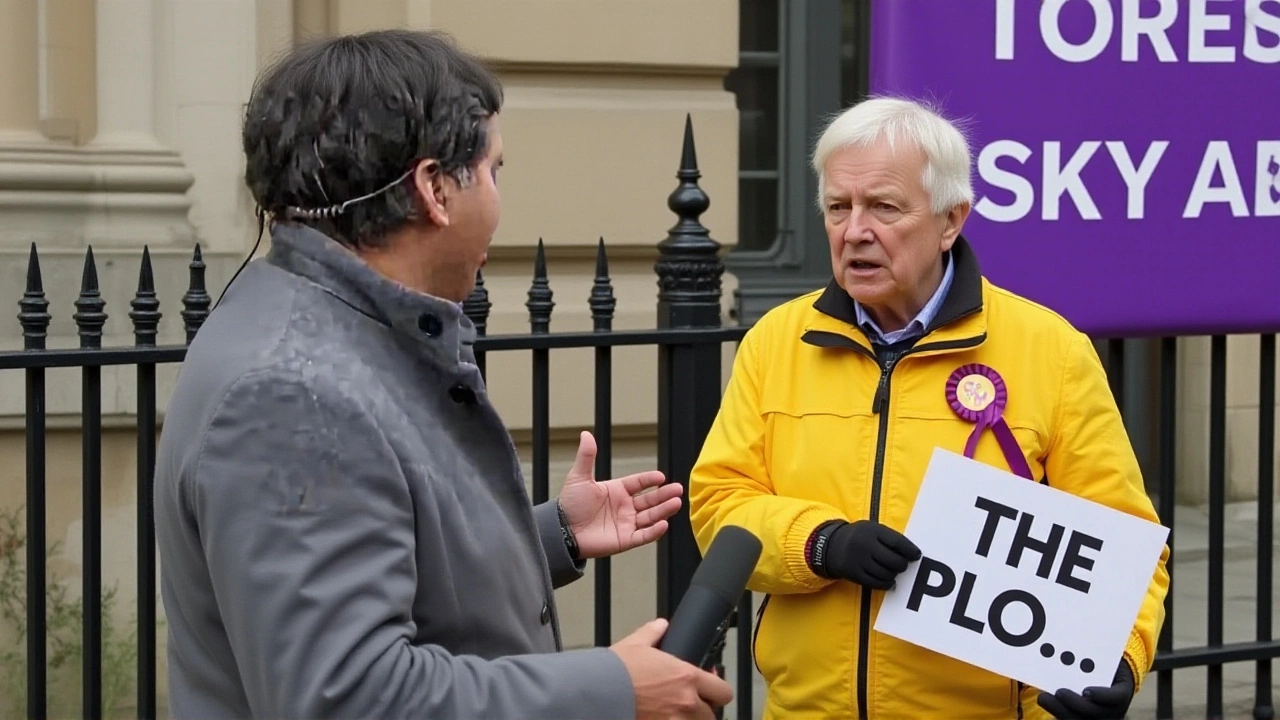
On Monday, November 24, 2025, Sky News’s daily Press Preview turned into an unexpected media firestorm — not just over tax hikes, but over who gets to define truth in British journalism. The show, streamed on YouTube under video ID 2hfBv0VLzC8, brought together Kevin Maguire, veteran columnist for the Daily Mirror, and a former First Minister (identity unconfirmed) to dissect a tangled web of political promises, leaked memos, and institutional rivalries. The conversation didn’t just touch on Chancellor Rachel Reeves’s rumored plan to raise income tax by 2p while cutting national insurance — a move that would hit pensioners harder despite her public assurances — it also exposed deep fractures in how Britain’s newsrooms report on the very thing that still divides the country: Brexit.
When the Tax Man Comes Knocking — Again
Rachel Reeves didn’t say it outright on Sky News at Ten on November 4, 2025, but she didn’t have to. When pressed on whether she’d rule out tax increases, she responded: “If we are to build the future of Britain together, we will all have to contribute to that effort.” The subtext? Pensioners, who don’t pay national insurance, might be asked to pay more in income tax. It’s a tactic not new — George Osborne did something similar in 2012, swapping NI cuts for income tax hikes to boost revenue without triggering voter backlash over “tax rises.” But this time, the backlash is coming from within Labour’s own ranks. One senior MP, speaking off-record, called it “a betrayal of the 2024 manifesto,” which explicitly promised no income tax increases. The Treasury’s internal modeling, leaked to Sky News, suggests the move could raise £1.8 billion annually — enough to fund NHS backlogs, but politically explosive.The Memo That Shook the BBC
Then came the bombshell: a 19-page internal memo by Michael Pascott, a former BBC journalist and Cardiff University media school graduate. The memo, leaked last week, wasn’t a call to burn down the BBC — far from it. Pascott explicitly rejected the Telegraph’s headline that the broadcaster was “institutionally biased.” Instead, he pinpointed three specific, troubling blind spots: coverage of the Panorama Reddit thread (where users dissected BBC reporting in real time), the Arabic service’s framing of Israel-Palestine, and how trans issues were handled in news segments. “It’s not about ideology,” Pascott told Sky News’s presenter. “It’s about consistency. When you treat one community with care and another with silence, you’re not neutral — you’re negligent.”The Telegraph, meanwhile, seized on the memo as proof of its long-standing claim that the BBC favors progressive narratives. But as the Press Preview host noted, “The Telegraph has a dog in this fight — commercially, because the BBC’s free-to-air reach dwarfs theirs, and ideologically, because the BBC doesn’t share their worldview.” That’s the real tension: not bias, but competition. The BBC’s 2024 annual report showed 41 million weekly users; the Telegraph’s digital audience? Just 7.2 million.
The Brexit Reset That Wasn’t
While media battles raged, the government quietly rolled out what it’s calling the “Brexit reset deal.” Announced at Lancaster House on November 20, 2025, the nine-page Cooperation Agreement promised £9 billion in economic growth — 0.3% of GDP — by improving agri-food exports, fishing quotas, defense collaboration, energy grids, and passport checks. But here’s the catch: nearly everything is “TBC.” No single market access. No customs union. No freedom of movement. The deal is essentially a technical upgrade, not a reversal.Prime Minister Sir Keir Starmer insisted it was “not a return to the EU,” but a “pragmatic reset.” Yet the polling tells a different story. A Sky News poll released on November 22 showed 55% of Britons now believe leaving the EU was a mistake — up from 48% in 2023. Among 18- to 25-year-olds — who were too young to vote in 2016 — the number jumps to 75%. That’s not just generational. It’s existential.
Who’s Really Winning the Narrative?
Conservative leader Kemi Badenoch called Starmer’s deal a “sell-out,” while Nigel Farage — once the face of Brexit — admitted to Sky News that “Brexit failed, not because of the idea, but because it was mismanaged.” Even Lord Alan Sugar, the billionaire entrepreneur, went on Good Morning Britain last week: “The biggest disaster in my lifetime? Leaving the EU. Get back in.”Meanwhile, the BBC’s editorial board quietly revised its guidelines on Brexit coverage — adding mandatory “historical context” segments before any piece mentioning the 2016 referendum. It’s a small change. But in a media landscape where trust is crumbling, even small steps matter.
What’s Next?
The government plans to unveil full details of the Brexit reset deal by December 10, 2025 — just before the five-year anniversary of the UK’s formal departure from the EU on January 31, 2020. Labour’s leadership is bracing for a rebellion among its own MPs, while the Conservatives are preparing a no-confidence motion. And the BBC? It’s quietly reviewing its trans and Middle East reporting teams, hoping to avoid another Pascott-style leak.One thing’s clear: the real battle isn’t over taxes or trade deals. It’s over who gets to tell the story of Britain — and whether the public still believes them.
Frequently Asked Questions
How does Rachel Reeves’ proposed tax change affect pensioners?
While pensioners don’t pay national insurance, they do pay income tax. Reeves’ plan to raise income tax by 2p while cutting NI would mean pensioners pay more overall, since their income is taxed but not subject to NI. The Treasury estimates this would raise £1.8 billion annually, mostly from the 1.2 million pensioners earning over £20,000 a year — roughly 20% of the total pensioner population.
Why is the Telegraph targeting the BBC over Brexit coverage?
The Telegraph sees the BBC as both a commercial rival — with 41 million weekly users versus its 7.2 million — and an ideological one. The BBC’s editorial stance leans centrist and evidence-based, while the Telegraph promotes right-leaning, sovereignty-focused narratives. The 2024 BBC charter renewal, which mandated “greater balance” on Brexit, was seen by the Telegraph as a capitulation to liberal bias — a claim the BBC denies.
What does the Brexit reset deal actually change?
The deal improves cooperation on agri-food standards, fishing quotas, energy interconnectors, and passport checks — but does not restore single market access, customs union membership, or freedom of movement. It’s a technical upgrade, not a reversal. The £9 billion economic boost is projected from reduced trade friction, not new investment. Key areas like financial services and digital data flows remain unresolved.
Why are young Britons so opposed to Brexit now?
Seventy-five percent of 18- to 25-year-olds believe Brexit was a mistake, according to a November 2025 Sky News poll. Many grew up with EU exchange programs, free movement, and access to European universities. They’ve seen the cost of labor shortages, higher food prices, and reduced research funding. Unlike their parents, they didn’t vote in 2016 — and now they’re paying the price.
Is Michael Pascott’s memo evidence of BBC bias?
No — Pascott explicitly rejected the idea of “institutional bias.” He identified three specific coverage gaps: inconsistent framing of Israel-Palestine in the Arabic service, underreporting of trans voices in certain segments, and reactive reporting on the Panorama Reddit thread. His concern was operational, not ideological. He called for internal audits, not external crackdowns.
What’s the timeline for the Brexit reset deal’s implementation?
Full details are due by December 10, 2025. Agri-food and fishing provisions are expected to take effect by March 2026, with energy and passport checks phased in by September 2026. The Treasury has warned that economic benefits won’t be measurable until late 2027, due to lagging trade data and delayed regulatory alignment.